
Fewer than one in 20 estates are subject to inheritance tax (IHT), with the average effective tax rate paid by taxpaying estates at 13%. The rate reflects the impact of exemptions, reliefs and tax-free allowances, according to government figures published this week.
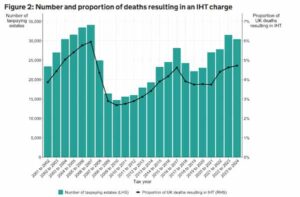
HM Revenue & Customs (HMRC) published figures relating to the tax year 2023-2024 in its annual Inheritance Tax liabilities statistics: commentary, which shows 4.72% of UK deaths in 2023-24 resulted in an IHT charge, a marginal increase of 0.1% on the previous year and the highest proportion since 2006 to 2007. Of those, 30,400 deaths were liable for IHT, a decrease of 1,100 (3.6%) compared to the previous year.
In its own commentary, HMRC suggests IHT is payable on fewer than one in 20 estates, as it has been since 2007 to 2008, and broadly since statistics were first produced.
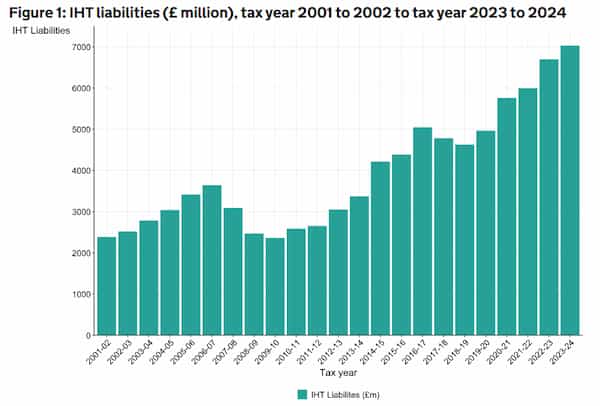
The government received £7.03 billion in IHT in the 2023-24 tax year, a rise of 5% on the previous year; most likely a result of “higher volumes of wealth transfers following recent IHT-liable deaths, recent rises in asset values, and the Government’s decisions to maintain the IHT tax free thresholds at their 2020 to 2021 levels.”
Charities continue to benefit from the tax-free allowances on offer, with the value of exempted transfers to qualifying charities increasing to £1.94 billion, from £1.92 billion in the tax year 2022-2023.
As a result of exemptions, reliefs and tax-free allowances, the average effective rate paid by estates was 13%, much lower than the headline rate of 40%. The largest exemptions continue to be for transfers between spouses and civil partners, which in the 2023-24 tax year saw £6.8 billion transferred to surviving spouses and civil partners on death – a rise of £0.82 billion (14%) on 2022-2023.
The exemption was used by 5,560 estates above the nil-rate band in the tax year 2023-2024, a rise of 490 on the previous year. The average amount of IHT paid across all taxpaying estates increased by 9% (£19,000) between the tax years 2022-2023 and 2023-2024, and now stands at £231,000.
London and the South East have the highest numbers of estates resulting in an IHT charge, at 4,810 and 6,310 estates respectively, between them accounting for over £3 billion of the total tax liability for the year; some 55% of the total IHT liability according to HMRC.
According to Kingsley Napley, Kensington contributed the largest amount of IHT geographically, with £107 million (down from £154 million last year). Cities of London and Westminster and Richmond Park followed. By volume of estates paying inheritance tax, Esher and Walton had the highest number of estates affected (up from third place last year), followed by Richmond Park and Chichester.
In constituencies in the north, Harrogate and Knaresborough paid the most IHT (£53 million) and Tatton had the most estates paying IHT (69). The top 20 localities paying the most IHT were all in London and the south east, with the exception of Edinburgh South (which ranked 13th ) where 103 estates paid a total of £41 million. South West Hertfordshire (ranking 18th) and Brentwood and Ongar (ranking 20th) in the east paying £37 million and £36 million respectively.
James Ward, head of the private client practice at Kingsley Napley, said: “As usual, London and south east constituencies top our leaderboard but the bigger picture is that more and more estates across the country were dragged into the IHT net for the year in question largely due to the fact tax bands have been stuck since 2009.
“For the last decade, of course, house price growth has been the primary driver of the year on year increased IHT haul but that may be about to change. The decision to make pensions subject to IHT from 2027 may well be a significant contributor to the tax take in future given it is expected this change will add approximately 10,500 more estates to HMRC’s sights.
“The big question, however, is what further changes to our inheritance tax regime are on the horizon under new PM Andy Burnham. Some are speculating he may abolish inheritance tax altogether in favour of a flat levy on all estates to fund social care reforms. Others think he may introduce this on top of the current regime and in addition to other property or land tax measures.
“We also know that various options remain open to him in terms of tweaks to the current IHT regime without breaking manifesto pledges. Reform of the gifting rules, use of the IHT nil rate band or residence nil rate band and removal of capital gains tax uplift on death for example are changes Rachel Reeves supposedly considered and could still be on the cards.”