There is, as yet, no case law on whether an AI chat log can be relied on in a contested probate claim, but it is surely only a matter of time. I’m not alone in seeing an increasing number of AI generated enquiries and responses to correspondence.
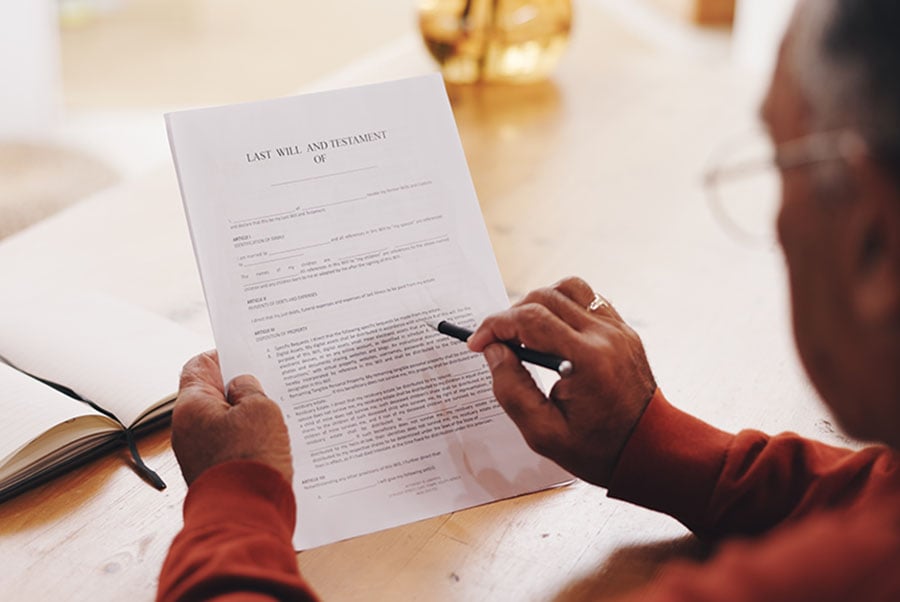
If testators are using it to make a homemade will, there may now be a record of the will making process where previously there was none. But whilst AI has its place, can it ever truly replace the role of a professional in the will writing process? And can the use of AI ever provide the same level of protection from a will challenge as the record of an experienced will writer?
Anyone who has brought or defended a will challenge will know that in circumstances where a will has been professionally drafted, the attendance notes of the will writer are crucial evidence. Comprehensive attendance notes enable the will drafter to respond to any questions with the certainty that whilst their memory may not be accurate, the record of their instruction is and a great deal of weight is placed on the testimony and records of the will writer for the very reason that their experience is valuable.
But what if there is no attendance note because the testator chose to prepare the will themselves? How do you prove the will isn’t a true reflection of someone’s wishes? Or, on the flip side, how do you prove you weren’t involved if there is no independent record of the will making process? Could AI be the answer, or is it going to make things even more difficult?
‘What needs to go in a will?’ ‘What is an executor?’ ‘Can a beneficiary also be an executor?’ ‘Do I have to include my daughter?’ These are all questions a testator may well ask AI. If they do, their questions and the responses given may well be stored, at least for a while. So could this record be used after their death to help bring or defend a will challenge? Could it “stand in” for an attendance note?
Who was asking?
In some respects, it could be helpful. If, for example, it was possible to prove that the testator’s own computer was used to consult AI, and anyone accused of being inappropriately involved was elsewhere at the time, it could absolve them. However, it is open to abuse. Someone deliberately trying to cover their back could use the testator’s computer and make it sound like it is the testator asking the questions. Unlike with a professional’s attendance note, it may be very difficult to establish who really asked them. Device evidence might help, but AI itself won’t be able to tell us. Nor is there any guarantee that the log is genuine or complete. Chats can be deleted selectively and a screenshot is easily edited.
What an attendance note gives the court
A professional’s attendance note should go further than recording basic information such as names and assets. It should record whether the professional thought the testator had capacity and if they had any concerns, what was done about them, such as whether the “golden rule” was followed. AI cannot assess whether the person asking the questions has sufficient capacity to make a will. That said, the questions themselves may assist. If, for example, the questions are coherent and sensible in the context of the will that has been created, and it is possible to prove that the testator was the one who asked them, this could help prove the will is valid. Equally, if the questions were obviously confused, this could point to a lack of capacity.
Getting hold of it
Nobody is obliged to keep a chat history, so how would you obtain a chat log after the testator’s death? It may no longer exist. Chats can be deleted, some are never saved, and accounts may be closed after death.
Even if it still exists, whilst it is possible to obtain a chat log for use in court proceedings, the process may not be straightforward, and a court order may be required. If it has to come from the provider an application for non-party disclosure under CPR 31.17 may be needed.
However, if the provider is based outside of the UK this will add another layer of complication as jurisdictional issues would need to be considered.
If you contrast this with a professional’s attendance note, where it is possible to simply write to the professional and request a copy as part of a Larke v Nugus request. It is an established principle that professionals should comply with such requests wherever possible and as soon as possible to avoid a costs order against them.
Other claims
Other claims, such as those for rectification, could be similarly affected. A professional’s attendance note should be clear as to what the deceased intended, even if the will itself isn’t. AI will only record precisely what was written. If the question is no clearer than the will itself, the chat log will be of limited use.
A weak substitute
Where a will is homemade, it may help to fill a gap, and it is worth asking early whether the deceased used AI. But it records only what was typed, not who typed it or whether they had capacity. It may not survive, it may be hard to obtain and it is easily challenged. In my view, it is no substitute for an experienced professional’s judgement.
About the author
 Georgia Stott is a contentious probate solicitor at Higgs LLP and a member of ACTAPS, specialising in complex and high-value estate and trust disputes, including 1975 Act and proprietary estoppel claims.