
The family of a 23-year-old RAF pilot who was shot down during the second world war have made an emotional journey to the place he died – after a team of Dutch researchers spent years piecing together his story.
Linda McLean and relatives travelled to the village of Neerkant, Netherlands, where her uncle, Flight Sergeant Arthur Burgess, was killed in 1943.
Arthur was just 23 when he died, on the very same date his twin sister Dorothy gave birth to Linda.
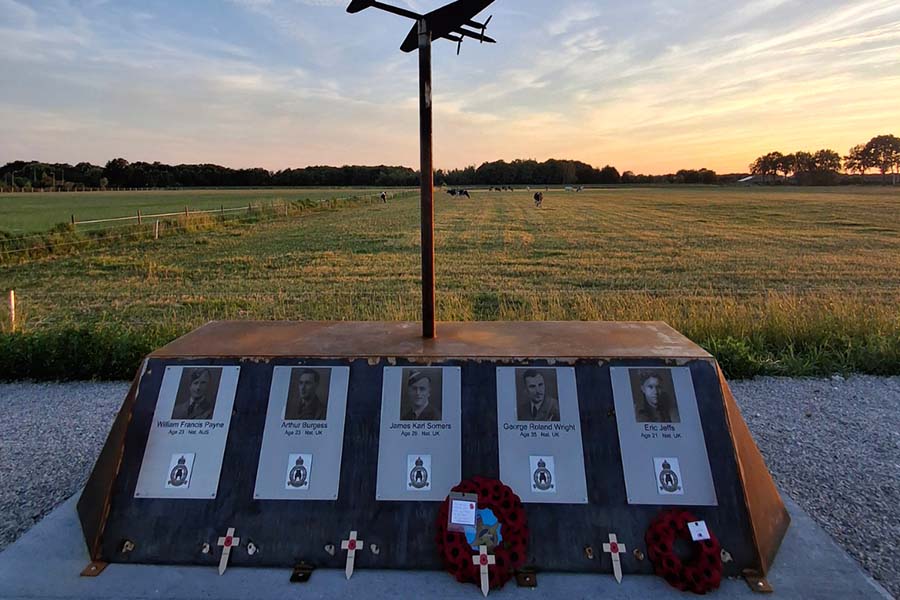
Now 83, Linda helped unveil a poignant, permanent memorial dedicated to Arthur and the four men who died with him. It is the first time the men have been honoured in such a way, following a lengthy project by local military enthusiasts.
“I actually don’t like to travel anymore, but I am glad I came,” said Linda.
“It is so beautiful and overwhelming, and now I also know who my uncle’s fellow crew members were.”
The unveiling brought together 22 relatives of the crew, two representatives of the Royal Air Force and members of Neerkant’s local community. The ceremony included a performance from a pipe band, songs by Vera Lynn, poems written and read by local schoolchildren and the laying of wreaths.
Arthur Burgess served with No. 166 squadron of the Royal Air Force Volunteer Reserve and was killed when his Vickers Wellington bomber was shot down near Neerkant on 22 June 1943.
Alongside Arthur were navigator George Roland Wright, 35, rear gunner Eric Jeffs, 21, wireless operator James Karl Somers, 29, and bomb aimer William Francis Payne, 23.
Four of the men were later buried at Jonkerbos War Cemetery in Nijmegen. William’s remains were never recovered, and he remains missing.
The unveiling marked the end of a seven-year project for Jürgen Beekers, a Dutch researcher who has dedicated much of his spare time to uncovering the stories of Allied servicemen killed during the war. His research grew into a 39-page dossier on Arthur, his crewmates, their aircraft and the crash, including the identities of the German pilots who shot them down.
The work also follows in the footsteps of Jürgen’s grandfather, who was a member of the Dutch resistance and helped downed RAF airmen escape back to Britain.
“My grandfather helped airmen like Arthur,” said Jürgen. “For me, this is still a big thank you to our liberators; thanks to them, my grandparents, their children and family got their freedom back.
“I have also been doing research into soldiers buried at the war cemetery in Nederweert for almost six years. By now, I have been able to track down photographs of 50 to 60 soldiers who are buried there.
“When people here in the Netherlands see a headstone on a war cemetery with just a name on it, you don’t really see a person,” he said. “But when you put a photograph in front of the grave, and you find some information about him, then you have a face, a story, a family.”
After a frustrating search for Arthur’s living relatives, Jürgen turned to Fraser and Fraser, the UK probate research firm behind television series Heir Hunters, which specialises in tracing long-lost family members.
Case manager Andy Loakes had previously helped Jürgen find the family of another British serviceman and began piecing together Arthur’s family tree.
“We drew up a full family tree and found that Arthur had five siblings with living descendants,” said Andy. “What we didn’t know was how extraordinary the story would turn out to be.
“Finding that Linda was born on the very night Arthur died, and that Dorothy’s ashes lie in front of his grave because of how close they were, that is the kind of story that reminds you what this work means.”
“These are not just names on records. They are people, and they have families who still carry them.”
Jürgen’s research also revealed details about Arthur’s RAF service that his family had not previously known.
Linda’s daughter, Kirsty Shurety, said: “I had not realised that he was a pilot. I’m questioning everything I thought I knew, but it made him real. He wasn’t just someone who lived two generations ago.”
“My gran believed she felt the moment he died. She told me that towards the end of her life. I know that she carried the loss with her always.”
“My mum talked about him always,” added Linda. “They were inseparable.”
The memorial itself took more than three years to complete and stands at the site of the crash in Neerkant.
Five stainless steel panels each carry a crewman’s name, age, country of origin and a laser-cut image of his face, while a Vickers Wellington above casts its silhouette onto the concrete below when the sun is high.
The wider site also includes a concrete trench from the second world war and seven columns bearing the names of 72 allied servicemen killed during the liberation of Neerkant.
Image: Fraser and Fraser
This article was submitted by Fraser and Fraser as part of an advertising agreement with Today’s Wills and Probate. The views expressed in this article are those of the advertiser and not those of Today’s Wills and Probate.