
The partner of a millionaire designer has lost a court fight over his fortune after a judge found that the fashion guru’s family “mattered more” to him than his lover and evidence of the pair living as a married couple was inconsistent.
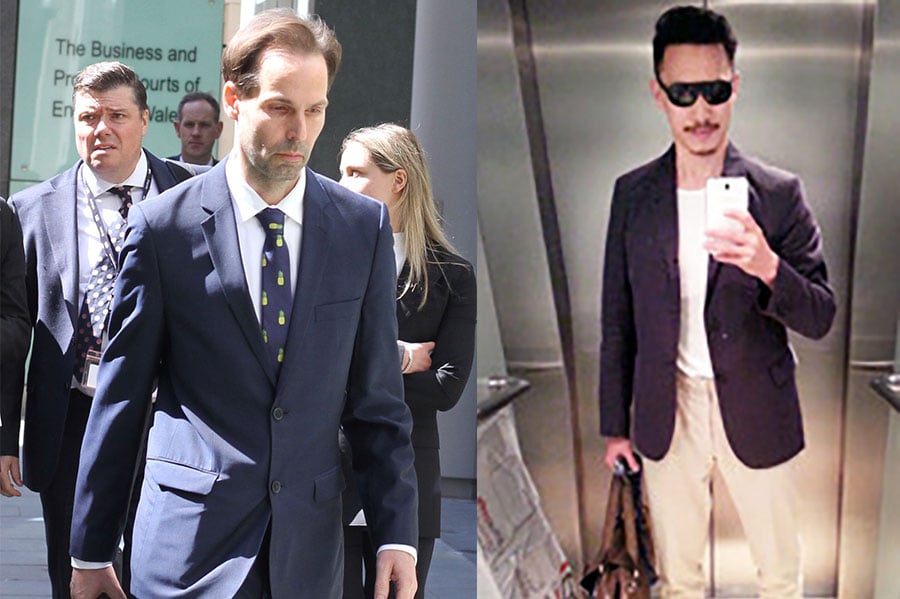
Designer Chris Liu (pictured right) died in 2017, with his “romantic and business partner” Tibor Matyas (pictured left) going on to launch a court bid for maintenance from the designer’s £1 million estate, which included two London flats.
Matyas claimed he had lived with Liu as a “married couple” for at least the final two years of his life, and the only reason the properties were not in joint names was because Liu’s family in China did not know the couple were in a relationship.
“My name couldn’t be on the property due to pressure from Chris’s family,” Matyas told the court.
After Liu’s death, a £470,000 flat automatically passed to Matyas as it was in both their names. The will also left a quarter share of another London property, with the rest of the estate going to Liu’s parents and brother in China.
Matyas sought a ruling under the 1975 Inheritance Act for “reasonable financial provision” out of the estate, claiming he had been “dependent” on Liu.
He insisted that he and Liu always understood the properties were jointly owned, that they lived together “as though they were a married couple” and the couple’s “joint income originated from the same source”.
Following his partner’s death, he said he had struggled to get his career back on track at the age of 50. The court heard that he also has significant debts, including legal bills from the fight, and wanted his financial needs to be met from the estate through a regular income stream.
He told the judge he has multiple needs, including for income and housing, as well as pet food, vets’ bills and kennelling for his dog at a cost of £3,800 a year.
But giving judgment after a trial at London’s High Court earlier this year, Deputy Judge Andrew Scott ruled against Matyas.
He said Liu had no “obligation or responsibility” to provide for Matyas when he died and had left most of his wealth to his Chinese family, who “mattered to him more” than his partner did.
And while Matyas considered the relationship “akin to a marriage”, Liu had been more “equivocal” about what it really meant, presenting it to some as like a marriage, but to others as a business relationship.
Giving judgment, the judge said that in order to have standing to make a claim as a spouse under the 1975 Inheritance Act, Tibor would have to show they lived openly as a “married couple” for at least two years prior to death.
“My assessment of the evidence overall is that Chris’ family mattered to him more than Mr Matyas did”, he said.
“Although there is some evidence that suggests that Chris and Mr Matyas were living together as a married couple, my view is that the balance of the evidence before me is not consistent with that conclusion.
“I am confident that Mr Matyas was in a relationship with Chris and I am also sure that, from Mr Matyas’s perspective, he most likely regarded it as akin to marriage.
“However, a marriage is necessarily between two persons and it seems to me that Chris was more equivocal about the relationship.
“Chris presented the relationship to his family as one of business colleagues and consistently did the same in correspondence with his solicitors, including expressly in his discussions for his will executed in the two-year period.
“The presentation of their relationship to public authorities was of persons living separately, not together. Chris involved Mr Matyas in his company, but only in a sales-focused, managerial capacity. Chris was the sole shareholder and director of the company and provided for the shares to go to his family, rather than Mr Matyas, on his death.
“Chris consciously kept much of his residential property in his sole name.
“There is some evidence that the relationship was presented to a relatively limited number of people as equivalent to one of marriage but, weighed against the other evidence, it is not enough to satisfy me that, throughout the relevant two-year period, Chris and Mr Matyas lived together in the same household as a married couple.”
He also found that, at the time Liuy died, Matyas was capable of looking after himself financially and needed no additional assistance.
“At the time of Chris’s death, Mr Matyas was only 39 years old. He had many strings to his bow from the point of view of his employment in the labour market,” he said.
“He had experience in information technology. He had significant experience in the fashion world. He had shown that he could act in sales or in marketing. He could act in a managerial or administrative capacity.
“In my view, he was, at the time of Chris’s death, capable of living independently and could manage perfectly well without any distribution from the estate.
“He could earn a good living from his own efforts irrespective of this significant property holding. In short, he was financially and professionally in an enviable position.”
He added: “I do not consider that Chris had any obligation or responsibility towards Mr Matyas. They did not live together as a married couple. Chris gave to Mr Matyas a significant proportion of the assets he owned at the date of his death. In so doing, he acted, in my view, generously towards Mr Matyas.
“However, Chris clearly did take his obligations towards his Chinese family very seriously. He was close to them. He spent time in China. He helped his father buy a property in China. In somewhat obscure circumstances, his family was also involved in Chris’ purchases of Kinetica and Atkins Square.
“Taking account of those matters, I consider that Chris’ will made such financial provision as it would be reasonable in all the circumstances for Mr Matyas to receive for his maintenance.”