
The High Court has awarded properties estimated to be worth up to £5 million to the wife of a deceased London property investor and restaurateur after declarations of trust signed before his death were found to have no legal or equitable effect.
In Gabriela Mozerle Teixeira v Amir Ahmad Moaven & Ors, Deputy Master Timothy Bowles ruled the story behind documents declaring that four properties in the name of Abbas Moaven, who died in 2012, were owned in one-third shares by himself, his brother Amir and their mother was a “fiction”.
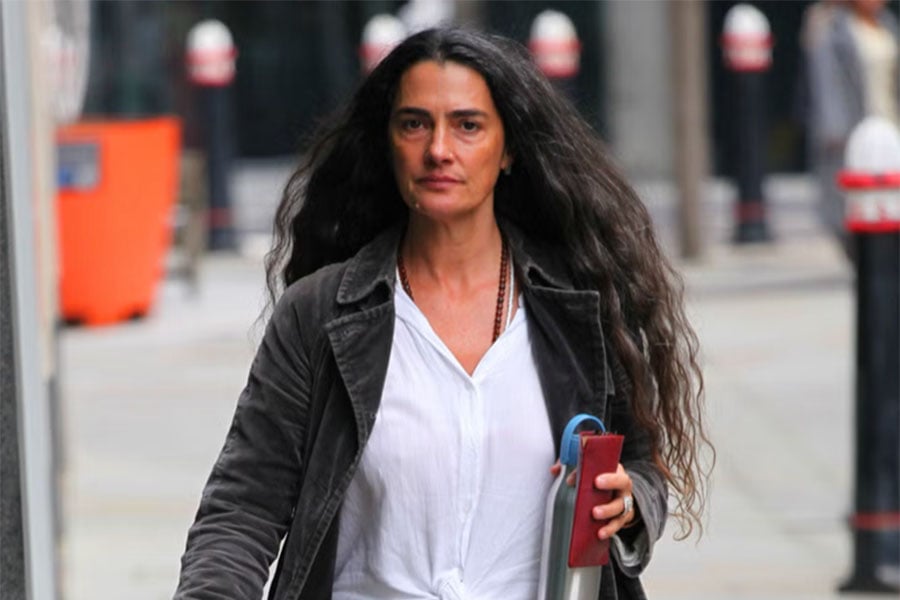
The court agreed that the properties did form part of the estate of Abbas Moaven and should be inherited by Ms Teixeira (pictured) and the couple’s two children.
The judgment is particularly important for contentious probate practitioners and professional independent administrators appointed into highly contested estates, according to Thomas Middlehurst, trust and estates partner at Ashfords LLP.
“The court has held that the declarations of trust relied upon to reduce the value of the estate were shams and had no legal or equitable effect,” he explained. “The result is that the relevant properties, which had been registered in the deceased’s sole name, fall fully within the estate.”
The decision is particularly significant, Middlehurst added, because of what it says about the role of independent administrators.
“The court recognised that personal representatives will often be expected to remain neutral where competing beneficiaries or alleged owners are fighting over an asset.
“However, the judgment makes clear that neutrality is not a rule to be followed mechanically. Where the question goes to the proper preservation and administration of the estate, and especially where the value or even solvency of the estate depends on the answer, independent administrators may be not only entitled but very arguably required to take an active position.
“For solicitor firms acting as independent administrators, the practical message is that the appointment is not a passive one. Administrators must get in and protect the estate. If there is credible evidence that estate assets have been wrongly diverted, concealed or placed beyond the estate through questionable documentation, simply standing aside may not be enough.
“The court expressly accepted that the administrators in this case could not be criticised for deciding that active involvement was appropriate and observed that it would very arguably have been wrong for them not to take and advance a view.
“That does not mean independent administrators should intervene in every dispute. There remains a costs risk if intervention is unnecessary. But the judgment provides helpful support for professional administrators who, after careful analysis, conclude that the estate’s interests require them to pursue clarity, challenge suspect arrangements and support the recovery of assets for the benefit of those entitled to the estate.”
The court heard that Ms Teixeira, a Brazilian national, and Mr Moevan, a businessman from Iran, were married in 2002 and lived together at a number of high value properties around London.
Following the death of Mr Moevan in 2012, Ms Teixeira learned he had signed the declarations of trust in favour of his mother and brother just weeks before, significantly reducing the value of his estate.
In her application to the High Court, Ms Teixeira claimed the documents were a sham designed to prevent her from accessing his wealth and asked the court to restore the properties to the estate, which was to be left in third shares between Ms Teixeira and the couple’s two children.
In court, Ms Teixeira’s barrister, Alexander Learmonth KC, argued that the documents were “obviously shams,” designed by Mr Moevan to prevent his wife or creditors from making a claim to most of his assets after his death.
He pointed to an attendance note from a meeting between Abbas’ solicitor and Amir, when Abbas was “seriously unwell” at home and his brother was seeking to “regularise their affairs”.
The lawyers’ note stated: “His concern was what would happen if Abbas passed away and his wife disappeared with the two children to Brazil. How could they prevent this, and how could they prevent her from having access to the funds from the property assets?”
A subsequent note following another meeting added: “Amir confirmed his main intention was to secure Abbas’ children’s welfare because he was certain that any assets passed over to Abbas’ wife would be dissipated.”
Mr Learmonth told the judge the notes “establish clearly that, if the declarations of trust were really intended to have any legal effect at all, then they were entered into with the clear aim of defeating a claim by Gabriela and/or her children against the estate”.
He continued: “Abbas never intended his various declarations of trust to effect any real change in legal relations or to divest himself of his beneficial interest.
“He merely intended them to be used insofar as necessary to ward off claims by Gabriela, or potentially creditors. They are obviously shams.”
However, Amir Moevan claimed that the four properties were only ever put into Abbas’ name for “cultural reasons” because he was the elder brother.
His barrister Lydia Pemberton described the row as a “very bitter family dispute”, but insisted the declarations were “the written manifestation of the long-standing agreement” that the properties were held by Abbas, Amir and their mother in equal shares.
“No doubt the claimants are deeply disappointed that Abbas’ wealth and the estate is not what they expected, but disappointment does not make a valid claim,” she told the judge.
She continued: “Shortly stated, Amir’s case is one of a pooling of resources between himself, Abbas and their mother, demonstrated by their years of joint business ventures.”
Giving judgment on the dispute, Deputy Master Bowles rejected Amir’s explanations of the trust documents as a “fiction” designed to cover up the truth.
“They were, quite simply, a means to an end, that end being to present Abbas’ estate as being very much smaller than was, in fact, the case and to do so by the purported confirmation of informal trust arrangements that had no basis in fact,” he said.
“Contrary to the false narrative set out in the recitals to declarations of trust, the properties are not and never have been held on the informal trusts alleged in those recitals and in the declarations of trust.
“The extrinsic evidence fully supports the view that Abbas has always been the legal and beneficial owner of the properties.
“They were documents without any legal, or equitable substance, designed, simply, to give a false impression to Gabriela and to the world, as to Abbas’ assets and as to his estate.
“I have no doubt, in this regard, given my findings as to the declarations of trust and the evidence, which support those findings, that the burden on Gabriela and her children to provide convincing evidence of ‘sham’, to a high standard, has been well and truly met.
“The declaration of trust are ‘sham’ because they were not intended either to create, or to confirm, the rights purportedly declared, but, rather, to convey to those to whom the declarations of trust were deployed that the ownership of the properties was different to what it actually was and, by extension, that Abbas’ estate, following his death, was different and very much smaller than that which it actually was.
“They were, simply, deceitful forms of words, which did not affect or limit Abbas’ legal and beneficial ownership of the properties, at the date of his death and did not, therefore, preclude the full value of the properties falling into his estate.”
Gabriela Mozerle Teixeira v Amir Ahmad Moaven & Ors [2026] EWHC 1215 (Ch)
Image courtesy of Champion News