


A London High Court case brought by a mother fighting for a share of her millionaire father’s estate is ‘an intriguing point of comparison’ with a 2017 Supreme Court decision, Birketts LLP partner Barny Croft says.
In both cases, the claimants were adult children excluded from a parent’s will, each with limited financial means, reliant on benefits, and with dependants.
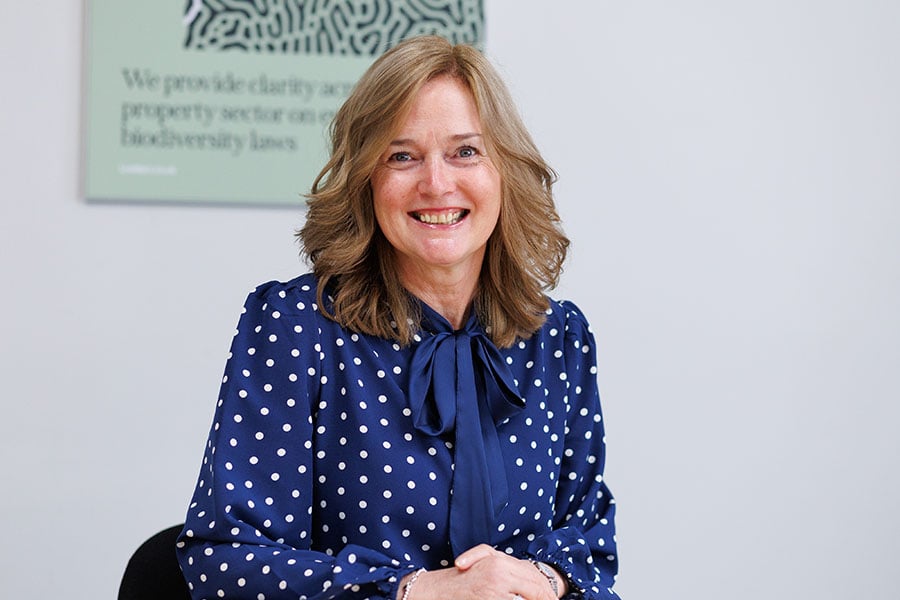
In the case heard this week, Emma McDaniel (pictured) is fighting her stepmother Rosemary Talbot for a share of the £1.75 million estate of Mark Talbot, who walked out when McDaniel was just eight months old.
Talbot subsequently became a millionaire through property investments and successful businesses. When he made his last will in 2014, he made a point of cutting McDaniel out, saying he had not seen her for 20 years and had no contact with her. But five years later, the pair met and belatedly developed a ‘close’ relationship which lasted up until his death in October 2022.
McDaniel, who has two disabled children and several health issues, runs a business and earns £5,000 a year in wages, relying on a ‘complicated cocktail’ of benefits to survive. She is now suing her former stepmother – who inherited the whole of Mr Talbot’s fortune – claiming that she should be given a payout as ‘reasonable provision’ from the estate.
The case bears many similarities to the Supreme Court’s decision in Ilott v Mitson [2017] UKSC 17, Croft points out. However, there are some important distinctions, he adds:
“In Ilott, the estate was modest at under £500,000 and the beneficiaries were charities, whereas here the estate is worth around £1.75 million and the sole beneficiary is the widow.
“Crucially, in Ilott the estrangement endured throughout the parent’s life, while in Emma’s case there was a marked change in circumstances after the will was made, with a renewed relationship and emotional closeness.”
London’s High Court heard that Mr Talbot had left Emma’s mother in 1985 and had never met Emma’s brother Rhys, who was born after he left. He went on to have a 36-year relationship with his new wife, with whom he had two more children.
Mr Talbot sold a successful courier business in 1997 and increased his fortune through a string of property investments and part ownership of Berkshire estate agents Cricketts. As well as his Berkshire home, by the time he died unexpectedly in October 2022, he had a string of rental properties and a £450,000 villa in Portugal.
The court heard that, although they spoke on the phone when she was 16, Emma did not see her father after he walked out until 2019, when he contacted her at the behest of his mother. The pair belatedly formed a ‘close’ relationship, including spending holidays at his villa, Judge Caroline Shea KC was told.
Mr Talbot had made a will in May 2014, leaving everything to Rosemary and specifically excluding Emma and Rhys, saying:
“I DECLARE that I have NOT made any provision in my Will for my son Rhys Winstone whom I have never met nor my daughter Emma Winstone who I last saw about twenty years ago. I do not have contact with either of them.”
By the time of his sudden and unexpected death in 2022, that will remained unchanged, despite father and daughter reconnecting.
Aiden O’Brien, for McDaniel, told the court that she is now applying for “reasonable financial provision” from her father’s estate to allow her to buy a home suited to the needs of her children and pay off her £50,000 debts.
O’Brien told the court:
“In 1985, the deceased decided to cut ties with the claimant, her brother and mother. Clearly, this was not the claimant’s wish, nor was it in her control. In 2019, the deceased sought out the claimant with a view to re-establishing a more normal father/daughter relationship.
“Whilst it is recognised that the deceased explicitly declined to provide for the claimant under the terms of the will, this was executed in 2014, at a time when a meaningful rapprochement was not in anticipation. The deceased died unexpectedly. It cannot be said that the views he expressed so firmly in 2014 pertained by the time of his passing.
“Emma is married with two children, both of whom have a constellation of disabilities. The claimant’s husband also suffers from heart and spinal problems. Unfortunately, the claimant also has her own health issues, including spinal problems, autism, ADHD, fibromyalgia, chronic fatigue and burn-out.
“The claimant lives with her family in a three-bedroom housing association property and they rely on an array of state benefits, supplemented by her modest business income. Emma and her family receive a complicated cocktail of state support, including Universal Credit, PIP, Child Benefit and Disability Living Allowance.
“The deceased’s net estate is relatively large, at circa £1,750,000. Emma avers that there is sufficient ‘head room’ to make an order in her favour, without causing any injustice to Rosemary. In stark contrast to the claimant, Rosemary has confirmed that she is in relatively good health and has no disabilities.”
George Woodhead, for Mrs Talbot, argued that the will should be followed and McDaniel should get nothing. He told the judge:
“After payment of funeral and testamentary expenses, the residue of the estate was bequeathed to Rosemary alone. It is submitted that Mark did not fail to make reasonable financial provision for Emma. It is submitted that it would be inappropriate to make an award.”
He said McDaniel has earning capacity and that her father had not provided her with financial support or assumed any responsibility to maintain her while he was alive. He had also been clear in that he did not want to leave anything for his children, including those he had with Mrs Talbot, the barrister continued.
The estate also represented the “joint efforts” of Mr and Mrs Talbot, since his focus on business “stopped Rosemary’s earning ability,” and effectively was her “pension.”
With McDaniel in the witness box, Mr Woodhead put to her that she had not been financially reliant on her father, telling her: “Mark’s death had no impact whatsoever on your resources.”
“I wouldn’t agree with that,” she replied, weeping as she told the judge that whilst she had previously managed to survive despite her difficulties, the death of her father had made things more difficult.
“It impacted my ability to work. It’s difficult to quantify. The grief was complex and it continues to be complex. It’s impacted my anxiety, fear for my own health and what that means.
“I spent a really long time working very hard to prove that I was good enough. In many ways, his death took away my purpose. I didn’t have long enough to recover from my dad not being in my life and feeling not worthy to him being gone again.”
Following a two-day trial, the judge judgement in the case to be given at a later date.
“When judgment is handed down, it will be fascinating to see how these differentiating factors influence the outcome and which considerations ultimately carry the greatest weight in this case,” Croft said.













One Response
I think Emma should have some provision