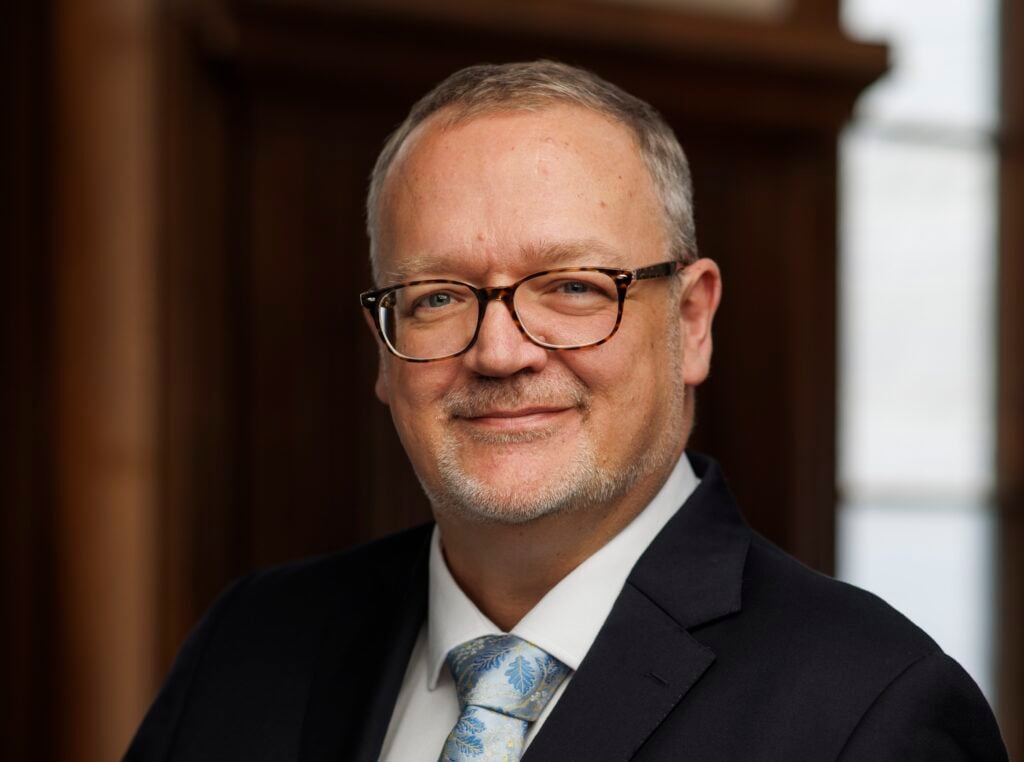

Today’s Wills and Probate sits down with new Law Society president Brett Dixon to discuss his ambitions for his tenure in office.
It is fair to say Brett Dixon has an unenviable task ahead of him.
As the leader of an organisation that represents 210,000 lawyers, and a myriad of interests, the Law Society of England and Wales has many differing, and sometimes competing, priorities.
The legal profession itself is undergoing monumental change. Regulatory challenges in the form of the current scrutiny on the Solicitors Regulation Authority, the transfer of oversight for anti-money laundering to the Financial Conduct Authority, and wider risk, compliance and ethics issues are all swirling, alongside the impact artificial intelligence is having on a profession reliant on the skill of interpretation; to the crumbling court infrastructure and legal aid deserts that continue to put pressure on access to justice.
It is, suggests Today’s Wills and Probate, an interesting time to be the figurehead.
“Each of us creates a plan for what we want to do in our year as president” explains Dixon.
“For me it focuses on two issues. It’s about access to justice and access to the profession. The latter bit is important because when you look around there are still problems particularly around disability access to the profession.”
Disability access is a very personal mission for Dixon whose daughter was born with a missing arm below the elbow. He has a particular interest in making sure people with disabilities are able to take part fully in life.
He cites national statistics which suggest only 23% of people feel able to have a conversation with their employer about their disability and request adjustments.
In the legal sector, that statistic is just 8%.
It is one of the reasons why he was so active in introducing the vulnerability reforms in the civil procedure rules and he intends to produce update guidance to support and encourage the conversation in the law.
Access to the profession is a recent news topic following the petitions by various organisations to make known opposition to proposals that would see the separation of compliance roles from law firm owners.
Are we not risking placing even greater pressures on access and diversity, by continuing to place onerous regulatory requirements on firms, where the impact is disproportionately felt by the very firms who best represent these ideals?
“I think there are two things if you stand back from that and look at it” says Dixon. “We have a government that talks about deregulation being important to unlock growth. There is always a need for regulation of some sort to keep people safe, set understandable expectations, and provide certainty as to what they’re going to get.
“What the profession is really asking for, and what the society is really talking about is understandable regulation, appropriate regulation, proportionate regulation.”
He is keen there is dialogue and welcomes the SRA’s decision to pause implementation of the separation proposals and set up working groups to listen to the experience of professionals.
“If we can get to a point where we have a regulator that regulates the profession in a way that’s understandable to it, that is a much better goal than just saying we don’t want this.”
Dixon’s own legal career started as a catastrophic personal injury lawyer before moving into writing court rules. He was instrumental in creating the rules most of the current civil digital systems are based upon. A proud northerner, a trait he shares with former president Nick Emmerson (Yorkshire) and immediate past president Mark Evans (North Wales), Dixon was born and brought up in Burnley, Lancashire and was the first in his family to attend university. He now lives in nearby Whalley.
Does he think the society is more aligned with its membership after it has faced criticism of being too London-centric, and out of touch with members?
“We are here to represent the members” he adds. “Our councils represents different aspects of the profession and sometimes there are aspects of what people want that are different depending on the type of work you do.”
It is Dixon’s view the organisation does a “good job of representing a very broad and proudly diverse profession” he adds.
As someone who has spent his life traversing many difficult questions as a litigator and mediator Dixon says the key is to try and find a landing ground; understand what the profession is looking for and what works for them is heard and has an impact and an influence.
“There are always bumps in the road in getting to a final outcome in relation to anything” he says encouraging members to actively participate in the various councils and representative groups the society offers in order to best effect change.
On the regulatory challenges facing the profession he is positive about the approach of the new leadership team at the SRA who he says are “making progress to get things done.”
Artificial intelligence and technology are huge opportunities he says, adding “justice has to look like and be understandable to the people who access the justice system.”
Crumbling court infrastructure, legal aid deserts, the “vanishingly small” number of criminal defence lawyers (where the average age of a duty solicitors is over 50 years old), and judicial recruitment are all sizeable issues the profession has to grapple with.
The society has been vocal on digitisation of conveyancing and will writing reform, asking the government to move toward implementation after the Law Commissions’ seminal report.
Dixon calls on the government to “start taking seriously the provision of legal aid.” Lawyers are part of their local community he says and it has become increasingly difficult for legal aid firms to represent their local communities, and provide local employment. Partners are making difficult decisions about work streams that offer more income that will ultimately enable them to support more staff properly he explains.
But, he concedes, it all takes time, and he is “conscious you have a year to do different things” as president.
“You have to be focused in the things that you want to do” bringing the conversation back to his own agenda in office.
“Access to the profession isn’t solely about disability, it’s also about social mobility. Talent isn’t just located in certain areas, it’s different postcodes, different ages.”
He decries the hard limit on age for solicitor apprenticeships where, for example in local authorities, it’s a challenge to find funding to support people into the profession.
At the end of an insightful discussion Dixon’s message is ultimately one of pragmatism rather than pessimism.
“It’s not just about quantity of justice, but quality as well” he concludes.